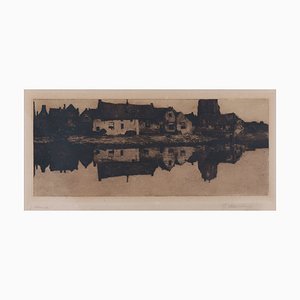
Hans Thoma (1839 Bernau - 1924 Karlsruhe), At the pond, 1897. Algraph on strong wove paper, published by Breitkopf und Härtel in Leipzig as ‘Zeitgenössisches Kunstblatt Nr. 148’, 23.8 cm x 45.5 cm (image), 40 cm x 50 cm (sheet size), signed and dated lower right. Verso with publisher's sticker.
- Small marginal tears and a crease in the wide lower margin, otherwise in good condition
- The longing of the landscape -
Although Hans Thoma is a landscape painter, it is unusual for him to depict an entirely deserted landscape. This gives the landscape an even stronger autonomy, turning it into a pictorial narrative. A wide stream flows into the painting from the right, widening into a small lake at its center. This movement is also toward the sun's rays, which bathe the plain behind it in light. The flow of the dark water becomes a gesture of longing for light that transcends the world.
About the artist
After failing to complete his apprenticeship as a lithographer, painter and clockmaker, Hans Thoma trained as an autodidact painter. In 1859 he won a scholarship to the Karlsruhe Art School, where he became a student of Wilhelm Schirmer and Ludwig Des Coudres. After graduating in 1866, Thoma spent time in Basel and Düsseldorf. He met Otto Scholderer, with whom he traveled to Paris in 1868. There he was impressed by the art of Gustave Courbet and the Barbizon School. After his works were rejected by the Karlsruhe Kunstverein, Thoma moved to Munich in 1870, where he was close to the Leibl circle. Wilhelm Trüber worked for a time in Thoma's studio in Munich. In 1874 he made the first of a series of trips to Italy with the painter Albert Lang, where he met Hans von Marées and Adolph von Hildebrand and became friends with Arnold Böcklin, whose art made a lasting impression on Thoma. On his return to Munich, Thoma became a student of Cella Berteneder, whom he married in 1877.
Thoma traveled to England in 1879 at the invitation of art collector Charles Minoprio. Over the years, Minoprio acquired more than 60 oil paintings by Thoma and organized the first exhibition of his art abroad in Liverpool in 1884. Thoma had lived in Frankfurt since 1878. The following year, the Frankfurter Kunstverein organized the first solo exhibition of his work. After a trip to the Netherlands, Thoma moved to Kronberg im Taunus in 1899, where the Kronberg painters' colony was based. That same year he was appointed professor at the Karlsruhe Art School and director of the Karlsruhe Kunsthalle. In 1901, together with Wilhelm Süs, Hans Thoma founded the Grand Ducal Majolica Manufactory in Karlsruhe, for which he supplied designs from then on.
Thoma was now at the height of his artistic fame. The 1909 edition of Meyer's Großes Konversations-Lexikon noted that Thoma had become one of the German people's favorite painters. On the occasion of his 80th birthday in 1919, Ernst Oppler and Lovis Corinth organized a large celebration. After Thoma's death, the Berlin National Gallery dedicated a major exhibition to him in 1922, and the Basel Kunsthalle in 1924.
Hans Thoma (1839 Bernau - 1924 Karlsruhe), En el estanque, 1897. Algrafía sobre papel verjurado resistente, publicada por Breitkopf und Härtel en Leipzig como «Zeitgenössisches Kunstblatt Nr. 148», 23,8 cm x 45,5 cm (imagen), 40 cm x 50 cm (tamaño de la hoja), firmada y fechada en la parte inferior derecha. En el reverso, etiqueta adhesiva del editor.
- Pequeños desgarros marginales y un pliegue en el amplio margen inferior, por lo demás en buen estado. - La nostalgia del paisaje - Aunque Hans Thoma es un pintor paisajista, no es habitual que represente un paisaje completamente desierto. Esto confiere al paisaje una autonomía aún mayor, convirtiéndolo en una narrativa pictórica. Un amplio arroyo fluye hacia el cuadro desde la derecha, ensanchándose hasta formar un pequeño lago en el centro. Este movimiento se dirige también hacia los rayos del sol, que bañan de luz la llanura que hay detrás. El flujo del agua oscura se convierte en un gesto de anhelo de luz que trasciende el mundo.
Sobre el artista Tras fracasar en su aprendizaje como litógrafo, pintor y relojero, Hans Thoma se formó como pintor autodidacta. En 1859 ganó una beca para la Escuela de Arte de Karlsruhe, donde fue alumno de Wilhelm Schirmer y Ludwig Des Coudres. Tras graduarse en 1866, Thoma pasó una temporada en Basilea y Düsseldorf. Conoció a Otto Scholderer, con quien viajó a París en 1868. Allí quedó impresionado por el arte de Gustave Courbet y la Escuela de Barbizon. Después de que sus obras fueran rechazadas por la Karlsruhe Kunstverein, Thoma se trasladó a Múnich en 1870, donde se acercó al círculo de Leibl. Wilhelm Trüber trabajó durante un tiempo en el estudio de Thoma en Múnich. En 1874 realizó el primero de una serie de viajes a Italia con el pintor Albert Lang, donde conoció a Hans von Marées y Adolph von Hildebrand y se hizo amigo de Arnold Böcklin, cuyo arte causó una impresión duradera en Thoma. A su regreso a Múnich, Thoma se convirtió en alumno de Cella Berteneder, con quien se casó en 1877.
Thoma viajó a Inglaterra en 1879 por invitación del coleccionista de arte Charles Minoprio. A lo largo de los años, Minoprio adquirió más de 60 óleos de Thoma y organizó la primera exposición de su arte en el extranjero en Liverpool en 1884. Thoma vivía en Fráncfort desde 1878. Al año siguiente, la Frankfurter Kunstverein organizó la primera exposición individual de su obra. Tras un viaje a los Países Bajos, Thoma se trasladó a Kronberg im Taunus en 1899, donde tenía su sede la colonia de pintores de Kronberg. Ese mismo año fue nombrado profesor de la Escuela de Arte de Karlsruhe y director de la Kunsthalle de Karlsruhe. En 1901, junto con Wilhelm Süs, Hans Thoma fundó la Gran Fábrica Ducal de Mayólica en Karlsruhe, para la que a partir de entonces suministró diseños.
Thoma se encontraba entonces en la cima de su fama artística. La edición de 1909 del Großes Konversations-Lexikon de Meyer señalaba que Thoma se había convertido en uno de los pintores favoritos del pueblo alemán. Con motivo de su 80.º cumpleaños en 1919, Ernst Oppler y Lovis Corinth organizaron una gran celebración. Tras la muerte de Thoma, la Galería Nacional de Berlín le dedicó una gran exposición en 1922, y la Kunsthalle de Basilea en 1924.










Contacta con nosotros
Haz una oferta
¡Hemos notado que eres nuevo en Pamono!
Por favor, acepta los Términos y condiciones y nuestra Política de privacidad
Contacta con nosotros
Haz una oferta
¡Ya casi está!
Para seguir la conversación en la plataforma, por favor completa el registro. Para proceder con tu oferta en la plataforma, por favor completa el registro.Exitoso
Gracias por tu consulta, alguien de nuestro equipo se pondrá en contacto contigo en breve.
Si eres profesional del diseño, por favor solicita aquí los beneficios del Programa comercial de Pamono